
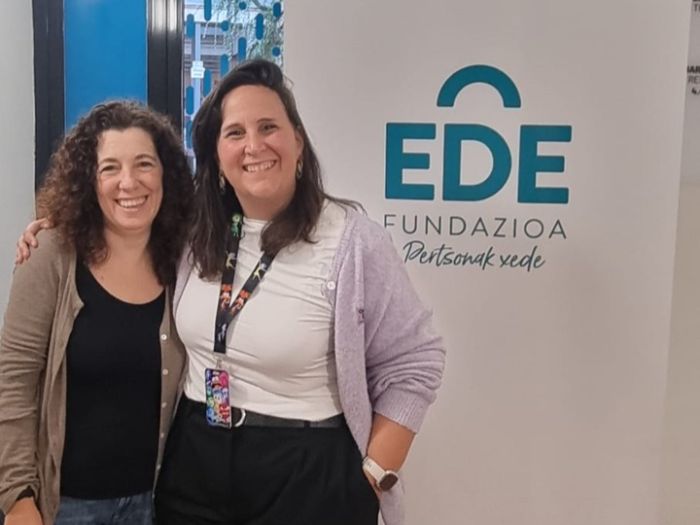
We spoke with Naiara San Martín (Tratu on+ coordinator), Anna Pallarés and Irati Izagirre. All three are members of the EDE Fundazioa team working on Tratu on+
Naiara, Tratu on+ is not starting from scratch. What lessons from the previous Tratu on project have been essential in shaping this new phase?
One of the key elements we felt was essential to preserve was the value of community building. Developing and shaping safeguarding policies based on organisations' experiences and local and collective learning.
It is also important to involve public authorities throughout the entire process, so that the project is genuinely built together. This helps create a shared understanding of the approaches, language, priorities and challenges involved, and encourages everyone to see them as a collective responsibility.
Anna, what made you feel that the time had come to take the project a step further and expand its reach?
We had spent several years developing our understanding and approach to positive treatment and child safeguarding through Tratu on, including experiences such as the one in Etxebarri.
We felt it was time to take the next step: systematise what we had learned and explore how to apply this methodology in other places and contexts.
We were excited by the idea of testing this approach in other territories, with different organisations and across different sectors.
The European CERV-Daphne call for proposals gave us the opportunity to make this a reality, bringing together organisations with complementary experiences and perspectives.
This is how the idea of pilot projects, or sandboxes, emerged: spaces to experiment, learn and build together, discovering how to adapt and enrich the model in different settings.
Ultimately, we wanted Tratu on to continue growing without losing its essence: building safer, more protective environments that promote positive treatment for children and adolescents.
Naiara, EDE Fundazioa is coordinating a larger-scale European project. What do you see as the main challenges of this new phase?
I would highlight three.
First, adapting the Tratu on+ model to different contexts without losing its essential principles. The realities on the ground can sometimes be complex and risk overshadowing the project's long-term objectives. But the project needs to remain sustainable in the long term.
Second, ensuring the participation of people from different sectors, each bringing their own backgrounds, needs, concerns and challenges. Helping everyone understand that safeguarding and positive treatment are collective and community responsibilities.
And third, involving public authorities in a project where the ways of working and pace are different from those they are usually accustomed to.
Tratu on+ brings together seven organisations with different backgrounds and experiences. Irati, what value does this diversity bring, and what opportunities does working together create?
Having such strong and diverse partners is a great opportunity to enrich the Tratu on+ model.
It allows us to place greater emphasis on emotional well-being; measure and systematise the model's impact across different contexts, identifying both common elements and differences; and raise the project's profile, sharing everything we do so that others feel inspired to get involved and bring the approach to their own municipalities... (Irati Izagirre)
When we talk about positive treatment of children and adolescents, what does putting it into practice actually mean in the everyday life of a community?
It means understanding our individual and collective responsibility for creating safe environments.
This is not just the responsibility of teachers, coaches or youth workers. Nor is it simply a matter for one department or professional.
It involves me personally. It challenges my actions and requires me to prepare and train myself.
It means being open to listening to others and working alongside them.
We need to recognise our shared responsibility for safeguarding, prevention, intervention and reparation following harm, each of us contributing from our own position.
And this responsibility also extends to organisations and institutions.
Anna, the participation of children and adolescents is central to Tratu on+. What do adults and organisations need to change to ensure their voices genuinely influence decisions that affect them?
Recognise children and adolescents as rights holders, with their own voices and the ability to contribute.
Be more flexible and not be afraid to adapt, embracing different paces where the process matters more than the outcome.
Simplify our language and step outside our comfort zones to connect with their interests.
Naiara, work is now beginning in the five pilot laboratories. What would you like to see happen in these spaces, and what do you hope to learn from them?
Above all, we would love these laboratories to become spaces for people and organisations to come together, particularly those working in the same area who do not always have the opportunity to collaborate.
We hope they will get to know one another, recognise what each can contribute and discover everything they can build together.
We would also like them to continue meeting and collaborating after the pilots have ended, having discovered the value of working as a network.
We also expect to learn a great deal from each experience: discovering new ways of collaborating and seeing how our tools come to life in different contexts, adapting to their needs, characteristics and unique perspectives.
Because that is also what Tratu on+ is about: learning together and building a model that grows richer through every community and every experience.
And finally, Anna, looking ahead to the end of the project in late 2027, what would need to have changed for you to feel that Tratu on+ had achieved its purpose?
We would like to see five communities that have taken a step forward in the way they develop policies for positive treatment and safeguarding children and adolescents, working in a more collaborative and coordinated way.
We hope that those who have taken part will feel the journey has been worthwhile, that they will want to continue working together and will be motivated to bring in new voices, perspectives and stakeholders to address new challenges as a community.
And above all, we hope that these five communities will be places where children and adolescents feel safer, better listened to and more actively involved in the decisions that affect them.
Because, ultimately, that is the true purpose of all this work.